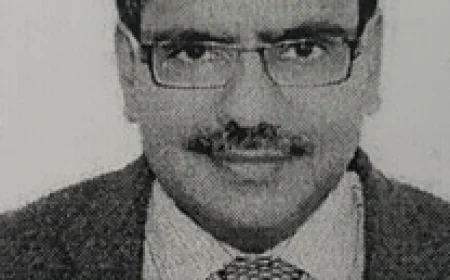



Sanjay Lathkar Appointed DG (Security) at Department of Atomic Energy After Post Upgrade
Sanjay A Lathkar has been appointed Director General (Security), Department of Atomic Energy, till September 30, 2028, after the post was temporarily upgraded.


Sanjay A Lathkar has been appointed Director General (Security) in the Department of Atomic Energy till his superannuation on September 30, 2028. The Centre temporarily upgraded the post of Inspector General (Security) from level 14 to level 16 in the pay matrix to make the appointment. He is a 1995-batch IPS officer of the Jharkhand cadre.
The Directorate of Construction, Services and Estate Management and the security organisation of the Department of Atomic Energy together handle physical protection of nuclear installations, fissile material and research facilities. The security head coordinates with the Central Industrial Security Force, which provides armed guarding at atomic energy units, and with the Atomic Energy Regulatory Board on the physical protection requirements that flow from India's obligations under the Convention on the Physical Protection of Nuclear Material. The post covers installations at Trombay, Kalpakkam, Tarapur, Kudankulam, Hyderabad and the uranium mining operations in Jharkhand. The department also operates research reactors, fuel fabrication facilities, heavy water plants and the fast breeder programme at Kalpakkam, each with its own protection requirements. Nuclear Power Corporation of India Limited, Bhabha Atomic Research Centre and the Indira Gandhi Centre for Atomic Research all fall within the security head's coordination remit.
Lathkar has completed about thirty-one years in the Indian Police Service. Officers of the Jharkhand cadre of his seniority have worked through districts affected by left wing extremism, held range Deputy Inspector General charges, and served in the state's special branch or anti-Naxal operations wing. Jharkhand also hosts the uranium mining and processing operations at Jaduguda run by Uranium Corporation of India, which gives officers of the cadre some familiarity with the security arrangements around atomic energy assets. Officers of the Jharkhand cadre have also handled the policing of mining and industrial areas in the state, including coal and iron ore belts where illegal extraction and transport are persistent problems. That work involves coordination with central public sector undertakings and their own security arrangements.
The upgrade of the post from level 14 to level 16 indicates that the department wanted an officer of Additional Director General equivalent rank in the security chair rather than one at Inspector General level. Upgrades of this kind are temporary and tied to the incumbent, reverting to the original level when the officer demits office unless a permanent restructuring is approved.
Nuclear security appointments are made by the Appointments Committee of the Cabinet on the proposal of the Department of Atomic Energy, which functions directly under the Prime Minister. The Centre has been raising the rank of security heads in scientific and strategic departments as the number and spread of installations has grown. India is building additional pressurised heavy water reactors at Kakrapar, Rawatbhata and Gorakhpur and has approved fleet-mode construction of ten reactors, each of which adds a site requiring a protection plan. The Central Industrial Security Force provides armed guarding at atomic energy installations and maintains a dedicated unit for the purpose, and the department's security organisation sets the protection requirements the force implements. Coordination between the two determines the deployment strength and the access control arrangements at each site.
The security organisation handles access control and personnel reliability at facilities, the transport security arrangements for nuclear material moving between sites, and the cyber protection of instrumentation and control systems, which the Atomic Energy Regulatory Board has brought within its inspection scope. Coordination with state police forces is required for the outer cordon around installations. India is not a party to the Nuclear Non-Proliferation Treaty but has placed a number of its reactors under International Atomic Energy Agency safeguards under the civil-military separation plan, and safeguarded facilities carry additional access and accounting requirements. The security organisation works with the department's safeguards cell on these arrangements.
The appointment runs till September 30, 2028, the date of Lathkar's superannuation. He belongs to the 1995 batch of the Indian Police Service, Jharkhand cadre.