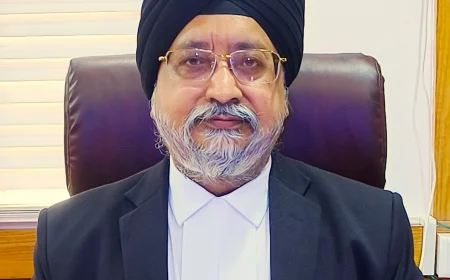



Sagar Singh Kalsi Shifted From Petroleum Ministry to Ministry of Power as Director Till February 2030
Sagar Singh Kalsi, an AGMUT cadre IPS officer, moves from Director in the Petroleum Ministry to Director in the Ministry of Power till February 23, 2030.


Sagar Singh Kalsi, a 2010-batch IPS officer of the AGMUT cadre serving as Director in the Ministry of Petroleum and Natural Gas, has been appointed Director in the Ministry of Power on lateral shift basis. His tenure runs up to February 23, 2030, the balance of his five-year deputation under the Central Staffing Scheme at the Director level.
Directors under the Central Staffing Scheme run subject desks within a ministry, drafting policy notes, handling parliamentary work, coordinating with attached offices and public sector undertakings, and processing the files that move up to Joint Secretary and Secretary. The Ministry of Power administers the Electricity Act, 2003, oversees the central generating and transmission companies, and handles distribution sector reform through schemes routed to state discoms. The ministry's attached and subordinate offices include the Central Electricity Authority, which handles technical planning and standards, and the Central Electricity Regulatory Commission, which sets inter-state transmission and generation tariffs. Public sector undertakings under the ministry include NTPC, Power Grid Corporation, NHPC, THDC, SJVN and the Power Finance Corporation and REC on the lending side.
Kalsi belongs to the AGMUT cadre, which covers the Arunachal Pradesh-Goa-Mizoram and Union Territories cadre, the joint cadre that supplies officers to Delhi, the union territories and those states. Officers of the cadre typically rotate between Delhi Police, union territory administrations and central ministry deputations, which gives the cadre a heavier central footprint than most state cadres of comparable size. Police officers serving under the Central Staffing Scheme in civil ministries hold the same Director and Deputy Secretary level posts as officers of the administrative and other central services, with the scheme drawing from a common pool. The arrangement is distinct from the deputation of IPS officers to central police organisations, which runs under a separate tenure policy.
His previous desk at the Ministry of Petroleum and Natural Gas sat on the hydrocarbon side: upstream exploration and production policy, refining and marketing, gas infrastructure, or the retail pricing and subsidy administration that runs through that ministry, depending on the desk allocated.
A lateral shift under the Central Staffing Scheme moves an officer from one central ministry to another without a break in the deputation period. The outer date of February 23, 2030 is carried over from the original five-year appointment rather than reset, which is what distinguishes a lateral shift from a fresh deputation. Lateral shifts are also used to move officers into ministries where a particular desk needs filling at short notice, without waiting for a fresh Civil Services Board recommendation and cadre clearance. From the officer's side, the deputation clock and the level remain unchanged; only the subject matter is different.
The Ministry of Power's current file load includes the distribution sector's financial position, the transmission build-out required to evacuate renewable capacity from the generation-heavy western and southern states, tariff and regulatory questions under the Electricity Act, and the energy storage and round-the-clock supply obligations tied to the non-fossil capacity targets. Distribution remains the weakest link in the chain the ministry administers. Aggregate technical and commercial losses, the gap between the cost of supply and realised revenue, and the accumulated dues owed by distribution companies to generators have been the subject of successive central schemes, each attaching reform conditions to funding for metering and network strengthening.
The appointment runs to February 23, 2030, being the balance of Kalsi's five-year Central Staffing Scheme tenure at the Director level.